DESIGN LANGUAGES · PRECISION LANDSCAPING & DESIGN
Geometric precision, architectural specimen planting, and a minimal palette — and how contemporary architecture demands a matched outdoor environment that doesn't undercut what was built inside.
Defining approach: Geometric precision, negative space as a design element, monochromatic palette. Nothing decorative for its own sake. Every element earns its presence.
Hardscape: Large-format porcelain (24x48 or 24x24, matte finish) in light gray, warm white, or concrete tone. Minimal joints, monolithic surface. Rectangular or L-shaped pool forms.
Plant palette: Three to five species maximum. Bismarck Palm as singular specimen, Agave at structural positions, tight Podocarpus screening where needed. Planting functions as sculpture, not garden.
SWFL adaptation: Modern's preference for open surfaces creates heat management requirements — louvered roof or shade structure over the primary seating zone is not optional in SWFL's direct summer sun.
Best suited for: Contemporary architecture — DeSanctis-style homes, modern custom builds in Grey Oaks new construction, Pelican Bay new spec homes. Buyer profile: 40–55, design background, clear aesthetic intent.
The problem with modern outdoor design in Naples is not demand — it is execution. A significant portion of new estate construction in Grey Oaks and Pelican Bay produces contemporary homes with outdoor environments that belong to a different design language. Clean, angular architecture opens to outdoor spaces with travertine pavers, rounded planters, and mixed tropical planting that undercuts the interior aesthetic entirely.
The correct outdoor design response to a contemporary home is a matched one. The same design principles that govern the architecture — precision, restraint, geometric clarity, negative space — govern the outdoor environment. The rectangular pool with no radius on its corners. The large-format porcelain deck with uniform joints. The single Bismarck Palm positioned precisely in relation to the pool axis. The outdoor kitchen that conceals its mechanical components rather than displaying them.
Modern outdoor design is the most demanding design language to execute correctly because it has no visual complexity to hide behind. Mediterranean outdoor design can absorb minor inconsistencies in plant placement or hardscape geometry — the style's richness covers the imprecision. Modern outdoor design cannot. Every element is visible, every proportion matters, and the result of imprecision is an outdoor space that reads as unfinished rather than minimal.
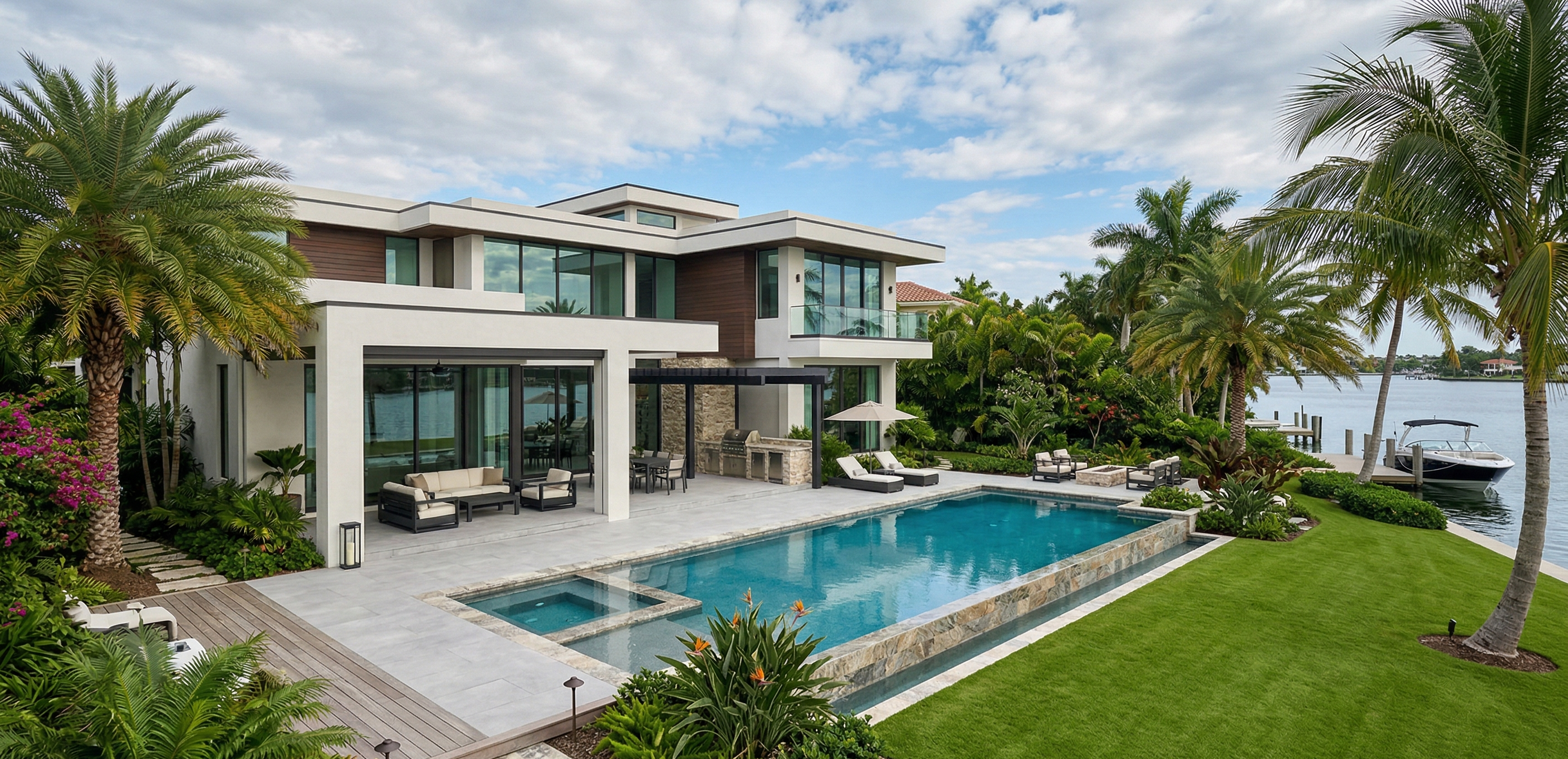
The rectangular pool — with square corners, no radius, consistent coping detail — is the correct pool form for modern outdoor design. The pool should be proportioned in relation to the available outdoor area: typically 12x28 to 16x40 feet on a standard estate lot, oriented to maximize the primary view corridor from the main living areas. The coping should be flush or near-flush with the deck surface, in a material that continues the hardscape language. No bullnose edge. No decorative coping profiles. The transition from pool edge to hardscape is resolved with geometry, not decoration.
Large-format porcelain pavers in a 24x48 or 24x24 format, laid in a running bond or stack bond pattern in light gray, warm white, or concrete tone, produce the monolithic surface that modern outdoor design requires. The minimal joints — achieved with 1/16 inch rectified porcelain — create the appearance of a continuous surface rather than a field of individual pavers. This is not achievable with travertine (which requires wider joints for thermal movement), concrete pavers (which require 1/8 inch joints minimum), or shell stone.
Porcelain is also the correct material for SWFL's climate: it requires no sealing, is salt-stable, and stays cooler underfoot in direct sun than concrete. The material selection is both aesthetically correct and technically appropriate.
The plant palette for a modern outdoor estate is a deliberate act of restraint. Three to five species maximum. Each species selected for its architectural form rather than its flowering or seasonal interest. Positioned with spatial intention — not filled in to cover ground, but placed where the form contributes to the composition.
The Bismarck Palm (Bismarckia nobilis) is the dominant specimen — its silver-blue crown against a white wall or minimal hardscape reads immediately as an intentional design element rather than landscaping. Agave attenuata (soft agave, no terminal spine) provides the low-profile geometric accent at pool edges and transition zones where foot traffic is present. Agave americana, with its sharper structural form and terminal spine, works at entry points and border positions away from the pool deck. Podocarpus macrophyllus, sheared to a tight column or flat panel, provides enclosure without visual complexity. Cycas revoluta (Sago Palm) at formal positions provides symmetry anchors without competing with the primary specimen choices.
Modern outdoor design's aesthetic preference for open, unshaded surfaces creates one substantive engineering challenge in SWFL: heat management. Naples receives approximately 2,800 hours of direct sun per year, with summer temperatures routinely exceeding 90°F before humidity correction. An outdoor environment designed for the visual openness that contemporary architecture requires — minimal structure overhead, large hardscape planes, spare planting — can become unusable during the May–October period without intentional shade planning.
The correct adaptation is not to compromise the aesthetic — it is to resolve the shade requirement in a way that is consistent with modern design's vocabulary. Louvered aluminum pergola systems (motorized, adjustable, powder-coated in matte charcoal or warm bronze) provide on-demand shade that fully retracts when the sun angle is acceptable. Their geometric, minimal form is compatible with modern outdoor design in a way that thatch, wood, or fabric shade structures are not. A louvered roof positioned over the outdoor dining zone and outdoor kitchen, with clean sightlines to the pool zone beyond, resolves the heat management requirement without compromising the visual character of the estate.
"Modern outdoor design is the one style where I will push back hardest on clients who want to skip the shade structure. In a temperate climate, you can have an open terrace with no overhead structure and use it all day. In SWFL, between June and September, an uncovered terrace is unusable from noon to 5pm. The shade structure is not an option — it is the functional requirement that allows the estate to be lived in."
— Thomas Ferrara · Precision Landscaping & Design
The outdoor kitchen in a modern estate is defined by concealment of mechanical complexity. No exposed gas lines. No visible refrigerator coils. No decorative tile that belongs in a different design language. The appliances are panel-integrated or flush-stainless with clean reveals. The counter is large-format stone in a single slab or continuous surface — no tile grout lines. The kitchen faces the pool zone, and the bar counter is oriented so the cook has a view of the outdoor environment rather than a wall.
Building a modern outdoor estate in Naples — pool, porcelain hardscape, louvered pergola, outdoor kitchen, specimen planting, and lighting — is a multi-trade, design-led project. Precision Landscaping & Design holds the GC license (FL CGC1539932) and executes the full scope under one contract. The landscape architect who specified the pool proportion and hardscape geometry is the same team that oversees construction. One design language, built by one team, from first drawing to turnover.
We design and build modern outdoor estates — geometric pool, porcelain hardscape, louvered shade structure, architectural specimen planting, and concealed kitchen — matched to contemporary architecture. Precision Landscaping & Design · FL CGC1539932.
Or read: Hardscape & Pavers · Pool Design & Build · Design Languages Guide