The Mediterranean Estate: Design Language for Naples
Why Mediterranean is the most natural luxury design language for Naples — and how SWFL's climate makes it more authentic here than almost anywhere in the US.
By Thomas Gow · 9 min read · Precision Landscaping & Design
The Quick Answer
Defining materials: Travertine or limestone hardscape, stone water features, wrought iron accents, formal clipped hedging. All authentic — not approximations — in SWFL's climate.
The organizing feature: The courtyard. Mediterranean outdoor design centers on a formal courtyard pool or garden court. Everything else radiates from it.
SWFL advantage: Travertine is cooler underfoot here than in Europe. Canary Island Date Palms are established estate trees in Port Royal and Grey Oaks. Bougainvillea thrives here the way it does at its source. This style is genuine here.
Key plant substitutions: Podocarpus for Italian Cypress. Viburnum for Box hedging. Sago Palms for formal symmetry. All climatically appropriate for Zone 10B.
Best suited for: Grey Oaks, Pelican Bay, Port Royal, and Mediterranean Revival architecture. The neighborhood and the style share a formal sensibility.
Why Mediterranean Is the Most Natural Design Language for Naples
Mediterranean outdoor design did not arrive in Naples as an imported style. It arrived as a natural match. The formal symmetry, the stone hardscape, the courtyard orientation, the clipped hedging, the specimen palms flanking a travertine driveway — these were already here, in the architecture, the HOA standards, and the expectations of buyers who purchased in Grey Oaks and Port Royal. Mediterranean landscape design is not what Naples clients are choosing. It is what many of them already have, often without naming it.
The practical case is equally strong. SWFL's climate supports authentic Mediterranean material and plant choices without compromise. Travertine performs better in Naples than in most European coastal climates — cooler underfoot in direct sun, structurally stable under SWFL's rainfall cycles, and resistant to salt air.
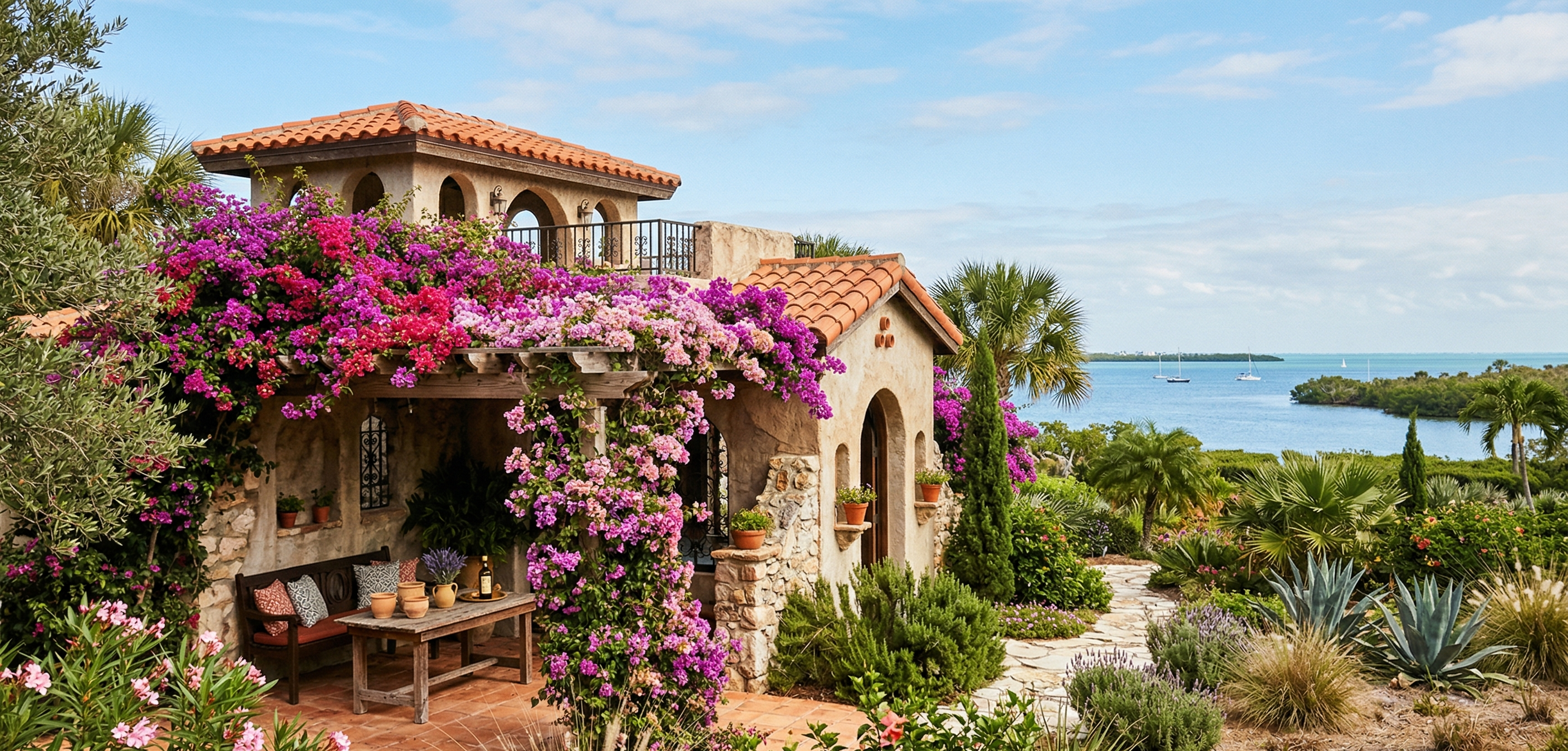
Bougainvillea — native to South America — thrives in Zone 10B the way it thrives at the source: as a full vine that covers a pergola structure in a single season, not a container plant kept alive through a Northern winter. Canary Island Date Palms are among the most established estate trees in Naples — planted here for decades, already at estate maturity on the best lots in Port Royal and Grey Oaks.
The result is that a well-executed Mediterranean outdoor estate in Naples is not an approximation of something European. It is a genuine expression of the design language, built with materials and plants that thrive here in ways they never could in a Northern climate.
The Defining Elements of Mediterranean Outdoor Design
Travertine and Limestone Hardscape
Travertine is the foundation material of Mediterranean outdoor design. Warm cream tones, natural veining, and a surface texture that reads as ancient stone — travertine delivers the visual weight and permanence that Mediterranean design requires.
On SWFL estates, travertine is also a practical superior: it stays measurably cooler underfoot than concrete in direct sun — typically 5–10°F — maintains structural integrity through SWFL's rainfall cycles, and is accepted by HOA architectural review boards across Grey Oaks, Pelican Bay, and Port Royal.
Limestone is the alternative — similar in aesthetic register but softer and more prone to surface staining near pools. Shell stone (coquina) is an authentic SWFL choice that reads as Mediterranean without being strictly European. Porcelain in cream or travertine-look is appropriate for Mediterranean contemporary where a lower-maintenance surface is the priority.
Specimen Canary Island Date Palms
The Canary Island Date Palm (Phoenix canariensis) is the Mediterranean estate palm. Flanking a stone-pillared gate, lining a formal driveway approach, or standing as an anchor specimen in a courtyard, the Canary Island Date Palm signals formal permanence. At 10–15 feet of clear trunk — the estate specification — it reads immediately as something that belongs. It is the Port Royal and Grey Oaks gate standard, and it is also the plant most closely associated with historic Mediterranean estates from Mallorca to Amalfi.
Formal Clipped Hedging
Clipped hedging is how Mediterranean design creates rooms outdoors — defining courtyard edges, framing view corridors, and creating the enclosure that makes outdoor spaces feel finished rather than open. In SWFL, Podocarpus macrophyllus is the primary substitution for Italian Cypress and Box hedging: it grows to 15+ feet, tolerates tight formal shearing, and handles Zone 10B heat and salt air that Box (Buxus) does not. Viburnum odoratissimum provides a dense formal hedge at lower heights. Both can be maintained at precise geometries that the Mediterranean aesthetic requires.
Stone Water Features
A central fountain, reflecting pool, or stone-clad water feature is the focal point of most Mediterranean courtyard designs. The water feature establishes the axis around which the courtyard organizes. In SWFL, water features are an engineering project as much as an aesthetic one — they require proper drainage design, recirculating pump sizing, and material selection that can tolerate continuous operation in high UV and salt conditions. Travertine-clad basins and cast stone fountain bases are the appropriate material choices.
Bougainvillea on Structure
Bougainvillea growing over pergola structures, along stone walls, or arching over an entry gate is the color signature of Mediterranean outdoor design. In SWFL, Bougainvillea is not a tender annual. It is a vigorous grower in Zone 10B, capable of covering a pergola structure within 2–3 seasons and producing its brilliant magenta, orange, or white papery bracts year-round in warm years. It requires a structural anchor — steel pergola or masonry wall — and directional training early in its growth cycle.
The Courtyard — The Organizing Feature of Mediterranean Outdoor Design
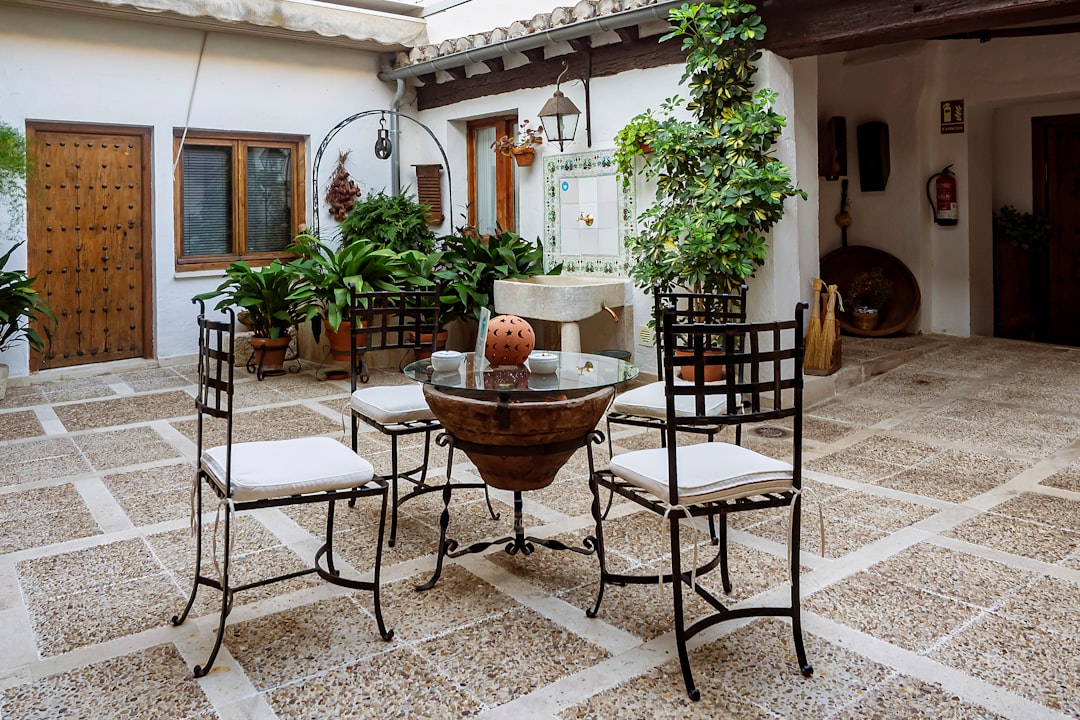
The courtyard pool environment is the central design statement of Mediterranean outdoor architecture. In its most fully realized form, it is a 2,000–4,000 square foot travertine-paved zone — pool at center, symmetrical planting flanking, pergola dining zone adjacent, fountain as the visual anchor of the primary axis. The home's principal rooms open to it. Every outdoor decision radiates from it.
In Grey Oaks and Pelican Bay, where new construction frequently includes an enclosed or partially enclosed motor court and entry sequence, the Mediterranean courtyard design extends naturally from the entry: travertine from street to front door, stone pillars at the gate, formal hedging along the approach, and a courtyard pool zone at the rear that completes the estate vocabulary.
"The courtyard pool is where Mediterranean design earns its cost. It's not just a pool — it's the outdoor room that every other zone in the estate serves. When we design a Mediterranean estate build at Precision Landscaping & Design, the courtyard proportions, the pool position within it, and the hardscape symmetry are the first design decisions — everything else follows."
What Building a Mediterranean Outdoor Estate Involves
A complete Mediterranean outdoor estate build in Naples is a multi-trade, design-led project. The scope typically includes:
Design phase: Landscape architect produces the courtyard plan, hardscape footprint, planting plan, and water feature specification. Engineering drawings for drainage and any structural elements.
Hardscape permit and construction: Travertine or limestone installation, motor court, driveway, courtyard pool deck, and any structural outdoor elements (pergola, gate pillars, retaining walls).
Pool and water features: Courtyard pool or reflecting pool, stone-clad fountain, water feature engineering.
Outdoor kitchen and pergola: Outdoor dining is central to the Mediterranean lifestyle. Pergola structure, kitchen appliances, stone or travertine bar surface.
Specimen planting: Canary Island Date Palms at gate and courtyard, Podocarpus formal hedging, Bougainvillea trained on structure, Sago Palms at symmetrical positions.
Lighting integration: Uplighting on specimen palms, wash lighting on stone surfaces, path lighting, water feature lighting.
Precision Landscaping & Design holds both the General Contractor license (FL CGC1539932) and the Landscape Contractor license to execute the full Mediterranean scope under one contract. No handoffs between firms. The design team that specified the travertine is the construction team that installs it — continuity from concept to turnover.
Frequently Asked Questions
Mediterranean outdoor design is built on travertine or limestone hardscape, warm terracotta accents, wrought iron details, stone water features, clipped formal hedges, and specimen palms. In Southwest Florida, travertine is climatically superior — cooler underfoot in direct sun, salt-resistant, and HOA-accepted in Grey Oaks, Pelican Bay, and Port Royal. This is a style that performs as well as it looks in SWFL's conditions.
Yes — more authentically than in almost any other US market. SWFL's climate supports true Mediterranean materials without compromise: travertine performs better here than in European climates, Bougainvillea grows here with the vigor it has at its South American source — not a greenhouse plant, a vine that covers a full pergola in one season — and Canary Island Date Palms are established estate trees in Port Royal and Grey Oaks. What looks like a stylistic choice elsewhere is genuine material performance here.
A full Mediterranean outdoor estate build in Naples typically starts around $150,000 for a coordinated multi-trade scope — travertine courtyard, stone water feature, outdoor kitchen with pergola, specimen Canary Island Date Palms, and formal Podocarpus hedging. Individual trades start at $30,000–$80,000 depending on scope. Contact Precision Landscaping & Design for a scope-specific conversation — no two estate builds are identical.
The Mediterranean plant palette translates directly to SWFL: Podocarpus macrophyllus for columnar screening (substitutes for Italian Cypress), Canary Island Date Palms as specimen anchors, Bougainvillea on pergola structures and walls, Sago Palms (Cycas revoluta) for formal symmetry at entry points, and Viburnum odoratissimum for formal hedge lines. Avoid Box hedging (Buxus) — it does not tolerate SWFL heat and humidity reliably.
The courtyard is the organizing feature of Mediterranean outdoor design. A central courtyard — whether a pool courtyard, motor court, or garden court — defines the spatial hierarchy of the estate. Everything else radiates from it: pergola dining zones, fountain focal points, flanking planting, and view corridors from the home's principal rooms. In SWFL estate design, a 2,000–4,000 square foot travertine courtyard pool environment is both the correct Mediterranean form and the correct design response to the climate.
Designing a Mediterranean Estate in Naples?
We design and build the full Mediterranean outdoor estate — travertine hardscape, courtyard pool, specimen palms, outdoor kitchen, and formal hedging — under one contract. Precision Landscaping & Design · FL CGC1539932 — permits through Collier County.