The Private Resort: Tropical Estate Design for SWFL
The most ambitious statement you can make with an outdoor estate. In Southwest Florida, it is also the most authentic — because the plant palette that defines resort design in Bali grows without substitution here.
By Thomas Gow · 11 min read · Precision Landscaping & Design
The Quick Answer
The defining statement: Tropical resort design turns an outdoor estate into a private resort compound — complete sensory immersion, not an outdoor living area with nice plants.
Water at the center: Lagoon-style pool with organic flowing edges. Infinity edge where view allows. Designed with hardscape and planting from a single plan — not added after the fact.
The SWFL advantage: Zone 10B is the only US climate where the full Balinese resort plant palette grows authentically. Bismarck Palms, Fishtail Palms, Traveler's Palms, Heliconias, Plumeria — all grow here without substitution.
Lighting as atmosphere: Warm amber uplighting hidden inside planting — not pole-mounted. The resort atmosphere after dark is built from light, not from fixtures.
Best suited for: Port Royal, Aqualane Shores, Pelican Bay, and properties with adequate depth for a true layered canopy — typically 60+ feet of planting depth behind the pool zone.
The Most Ambitious Statement — and the Most Authentic One in Naples
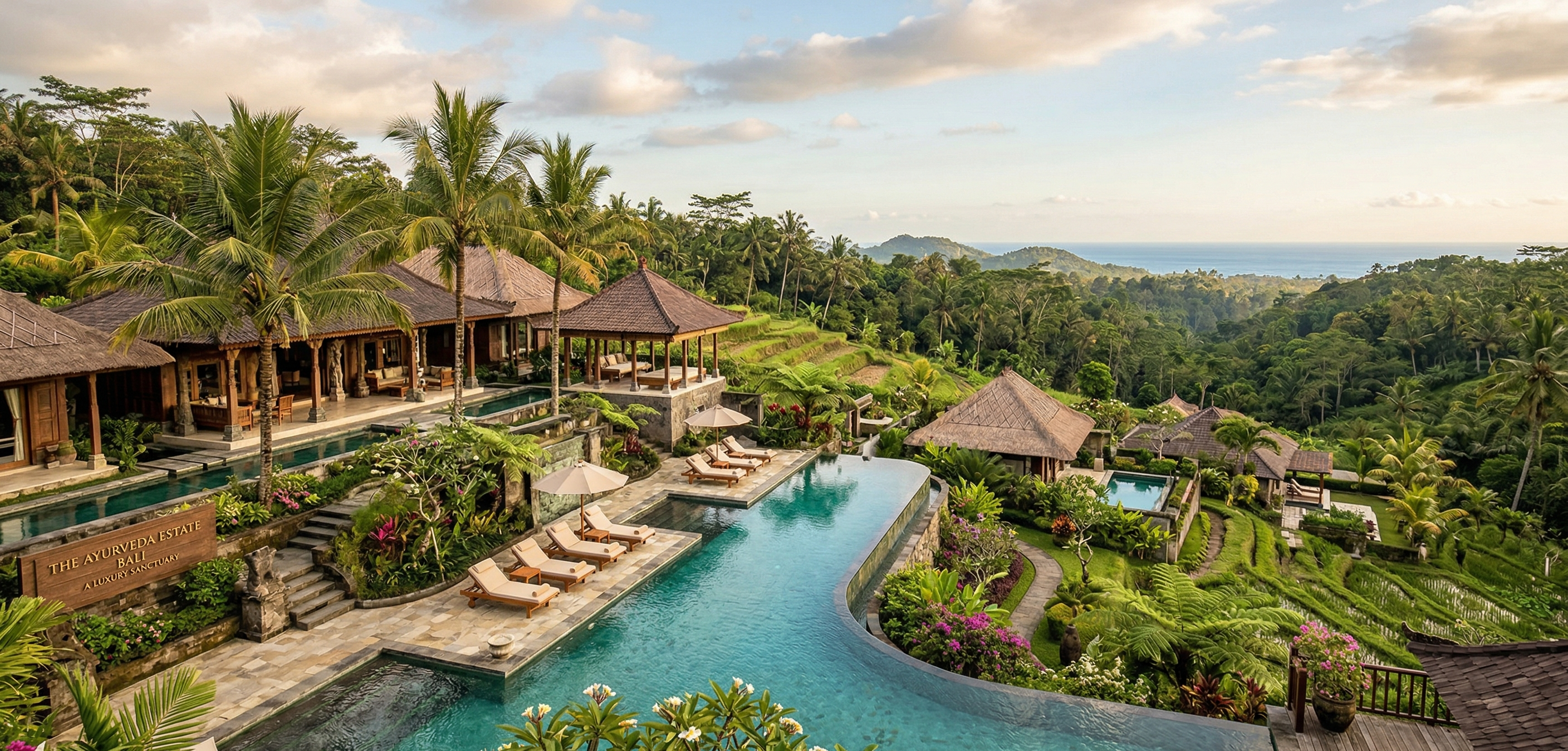
There is one design goal that requires no defense in Naples: build something that feels like a private resort. Not a house with a nice pool. Not a well-planted outdoor living area. A complete environment — lush, layered, immersive — where arriving home feels like arriving somewhere exceptional.
In most US markets, this goal is an approximation. The plants that define Balinese resort design — the towering Bismarck Palms, the feathery Fishtail Palms, the architectural Traveler's Palms, the Heliconias in the understory — require a tropical climate to grow as they should. In Chicago, Atlanta, or coastal California, the resort aesthetic is achieved through substitution: hardier plants that gesture at the look without delivering it.
In Zone 10B, there are no substitutions. The same plant palette used in Bali's leading resort estates grows on Naples properties year-round, without protection and without compromise. The Bismarck Palm that anchors a Port Royal outdoor estate is the same species anchoring the entry sequence at a Ubud resort. SWFL is the only continental US market where tropical resort outdoor design is genuinely authentic — not approximated.
What Tropical Resort Design Actually Means in Built Form
"Tropical resort" is frequently invoked and rarely defined. In built form, it has five distinct characteristics — each of which must be executed correctly for the whole to work.
Lush and Layered, Not Just Planted
Resort planting is not a single palm species repeated at regular intervals. It is a canopy layer (tall specimen palms — Bismarck, Royal, Fishtail — at 20–35 feet), a middle layer (Traveler's Palms, Heliconias, broad-leaf tropicals), and a ground layer (Bromeliads, ferns, Mondo Grass, low Gingers). The layers overlap. Density is the goal. The objective is to create the visual impression that planting arrived before the hardscape — that the pool was carved out of a garden, not a garden was arranged around a pool.
Water as the Theatrical Center
In resort design, water is not a feature added to the outdoor environment. It is the organizing principle of it. A lagoon-style pool with organic, flowing edges becomes the center around which every other element — the pool deck hardscape, the outdoor pavilion, the planting zones — is positioned. Overflow urns, koi features, and spillover water walls add water sound throughout the estate, not only at the pool. The resort experience is partly auditory — the sound of moving water is as important as its visual presence.
Organic Hardscape, Not Geometric Pavers
Geometric rectangular pavers, travertine grids, and formal courtyard symmetry are the correct hardscape language for Mediterranean design. For tropical resort, the hardscape should feel grown rather than imposed — irregular natural stone, flagstone with planted joints, smooth concrete with embedded pebble aggregate, organic edge pools. The hardscape reads as something that accommodates the garden rather than defining it. In practical terms, this means more complex pool edge detailing, irregular cut stone, and a planting plan that bridges the hardscape and garden zones rather than stopping at a defined line.
Warm Amber Lighting Hidden Inside the Planting
The lighting approach that defines resort atmosphere — warm, ambient, sourceless — is produced by uplighting placed inside plant beds rather than on surface-mounted poles. A Bismarck Palm lit from directly below with a warm 2700K fixture reads as part of the garden, not as a lit object. LED strip lighting hidden beneath pool coping, recessed step lights flush with stone, and water feature illumination all contribute to an atmosphere where the estate glows rather than where light fixtures are visible. This is the lighting design discipline that most residential projects miss.
The SWFL Tropical Estate Plant Palette
The plant palette is where SWFL's Zone 10B produces a genuine competitive advantage over any other US market. These are not approximations. These are the species.
Bismarck Palm
Bismarckia nobilis
The statement canopy specimen. Silver-blue crown spanning 8–14 feet at maturity. Trunk diameter communicates permanence the way no other palm can. Single-specimen focal point or used in groupings of three at estate scale. Field-grown specimens at 8–12 ft clear trunk height are the estate specification.
Fishtail Palm
Caryota mitis
Multi-trunk clumping form with uniquely textured leaflets that read as feathery from a distance. The Fishtail provides the middle-layer lushness that Bismarck and Royal Palms cannot — a dense, layered canopy that the resort aesthetic requires between the tall specimens and the ground plane.
Traveler's Palm
Ravenala madagascariensis
The most architectural tropical plant in Zone 10B. Fan-shaped crown spanning 15–20 feet, with leaves arranged in a single plane. Unmistakably exotic. Used as an accent specimen — one or two per estate — positioned where the architectural form creates a view focal point from the pool zone or outdoor pavilion.
Heliconia
Heliconia spp.
The tropical understory workhorse. Bold, waxy leaves in multiple green tones, with dramatic flower bracts in red, orange, and yellow that produce estate-scale tropical color without requiring maintenance. Heliconias grow vigorously in SWFL and fill understory zones that would otherwise require constant replanting with annuals.
Plumeria
Plumeria rubra / obtusa
The fragrance layer of the resort experience. Plumeria in bloom produces the scent that signals arrival at a tropical estate. Positioned near outdoor pavilions, pool edges, and garden pathways where the fragrance can be appreciated. Bare in winter months; spectacular in flower from April through November in SWFL.
Areca Palm
Dypsis lutescens
The privacy hedge of the tropical estate. Dense multi-trunk form, 15–20 feet at maturity, with feathery fronds that move in the breeze and create constant motion in the garden. Areca Palms at full estate height provide complete visual screening while reading as garden rather than fence. Field-grown, not nursery-staked.
"Palm grading is the variable most buyers don't think about until it's too late. A field-grown Bismarck Palm at 10 feet of clear trunk — grown slowly, without forcing — looks entirely different from a nursery-grown specimen pushed with fertilizer. The trunk diameter is different. The crown density is different. The permanence it reads as is different. At Rock & Rose, we grade specifically for estate specifications because the estate client will see the difference immediately."
— Thomas Gow · Precision Landscaping & Design
The Pool as the Center of the Environment
In tropical resort design, the pool is not a feature positioned in an outdoor area. It is the outdoor area's organizing center. Everything — the hardscape footprint, the planting zones, the pavilion orientation, the lighting plan — is designed in relation to the pool edge.
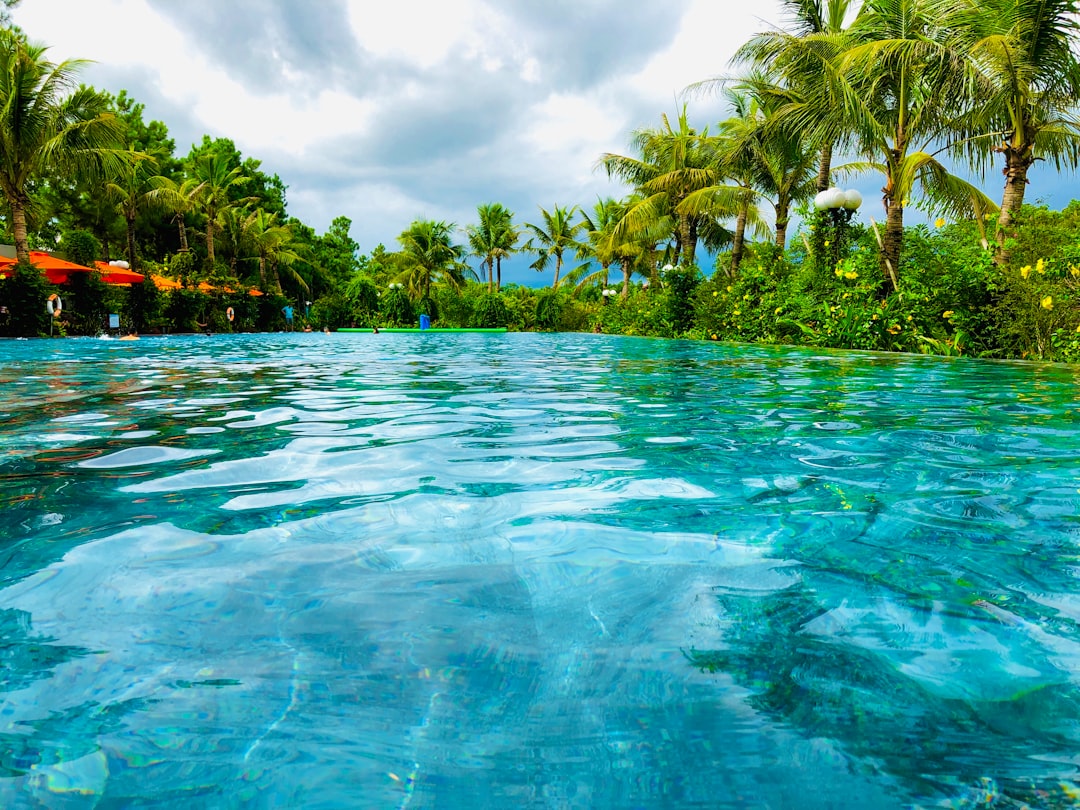
The correct pool form for this style is lagoon-edge: organic, flowing edges with no straight lines. The pool appears to have been placed into a garden rather than poured in a yard. Pool coping that transitions into irregular stone or pebble bands, planting that grows to the edge, overflow features that connect pool to hardscape with moving water — these are the construction details that produce the resort look.
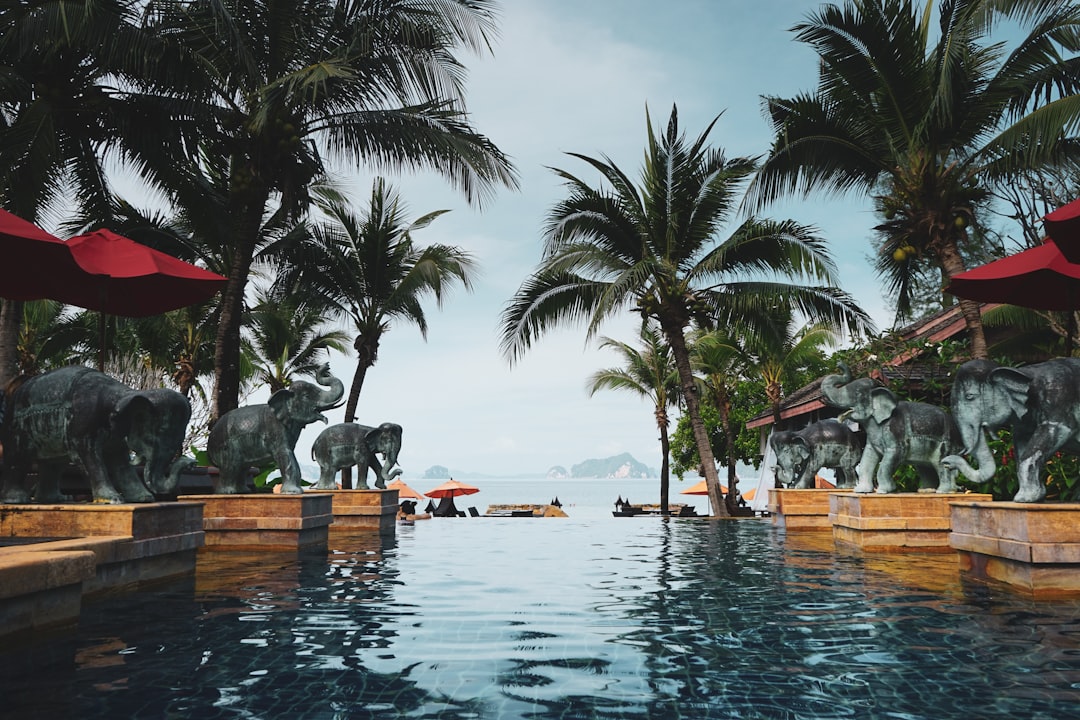
On properties with the elevation to permit it, an infinity edge is the signature statement. In Naples, where much of the market is near mean sea level, true infinity edges are achievable on elevated lots and on properties with a canal or lake view. The infinity edge requires precise structural engineering — the balance tank, the pump sizing, the coping height relative to the finished pool deck elevation — all coordinated before a single pour of concrete.
Why the Pool Must Come First
This is why the pool must be designed alongside the hardscape and planting plan — not after them. The pool contractor who designs the edge without knowing the hardscape finish elevation fails. The hardscape contractor who specifies the pool deck stone without the pool coping profile fails. These are construction coordination failures that cost significantly more to correct after installation than to prevent in design.
The Outdoor Pavilion: Shade, Kitchen, and the Living Core
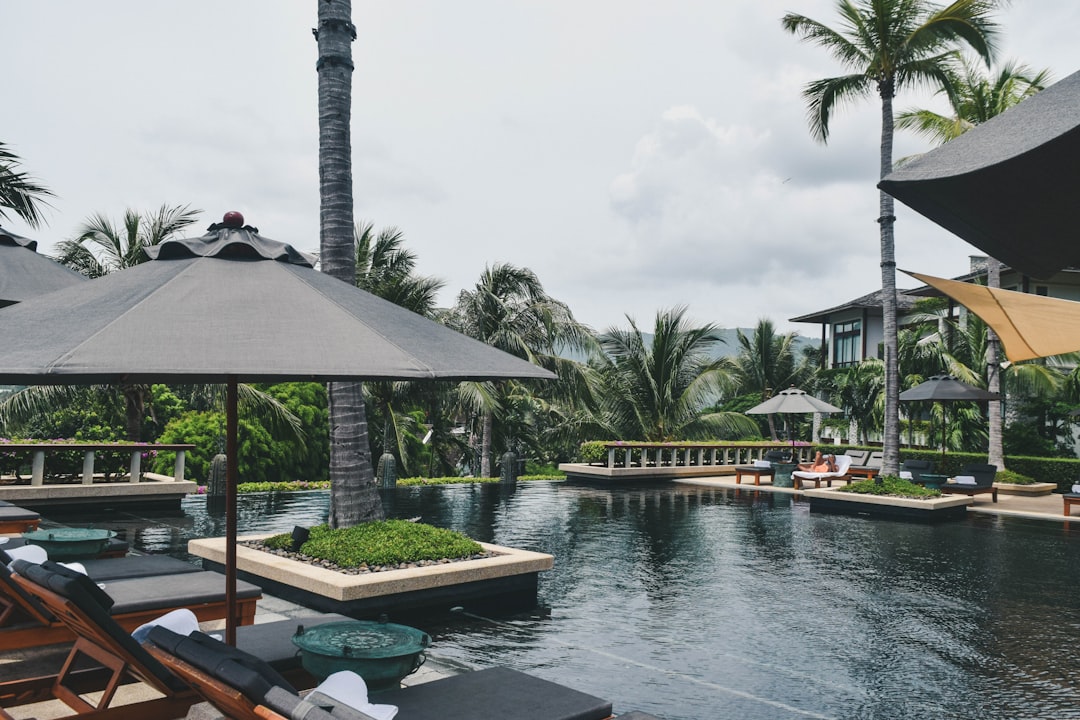
The outdoor pavilion — a covered structure connecting the pool zone to the outdoor kitchen and lounge — is the equivalent of the great room in tropical resort design. It is where the estate is lived in. Getting it right requires the same construction discipline as the pool edge: structural engineering, salt-air-appropriate materials, and integration with the surrounding planting.
Structural Reality in SWFL
Thatched roof pavilions are the visual signature of Balinese resort design. In SWFL, authentic thatched structures are achievable — Chickee-style construction, permitted and hurricane-rated — but require a licensed contractor who understands the load requirements for a coastal zone. The alternative, which achieves the same aesthetic at higher durability, is a powder-coated steel structural frame with synthetic thatch or high-grade fabric shade panels. Powder-coated steel in bronze or dark graphite with appropriate sheathing reads as a resort structure while meeting SWFL's 150+ mph wind load requirements and resisting salt air corrosion that would compromise wood in three to five years.
The Outdoor Kitchen for Resort Entertaining
Outdoor kitchen design in the tropical resort context prioritizes the social experience of cooking outdoors in a garden environment. The kitchen is positioned adjacent to the pavilion dining zone, with a bar counter that faces the pool. Appliance selection for this style emphasizes visual restraint — stainless or panel-integrated appliances, stone counter surfaces (granite, quartzite, or porcelain in dark or warm neutral tones), and a grill position that allows the cook to face the outdoor environment rather than a wall. Precision Landscaping & Design holds all outdoor kitchen trades under one contract — no separate kitchen subcontractor handed a finished slab to work on.
The lighting design discipline that most residential outdoor projects miss is the difference between lighting fixtures and lighting atmospheres. In resort design, the fixtures are invisible. The atmosphere is everything.
Palm uplighting is the foundation of the tropical estate at night. A Bismarck Palm lit from directly below with a 2700K warm white LED fixture — positioned at the base, aimed up through the center of the crown — produces a silhouette that reads as a natural tropical nightscape rather than a lit object. The fixture is buried in the mulch bed. The crown glows. Areca Palm hedges lit from the ground upward create a wall of warm light that provides privacy through visual softness rather than through darkness.
Water feature lighting contributes the ambient layer: LED strips beneath pool coping at the waterline, submersible fixtures at pool floor level in 2700K warm white, spillover water walls lit from below. The effect at dusk is that the pool glows from within rather than being lit from above.
Step lighting, path lighting, and pavilion ambient lighting complete the picture. Recessed LED step lights flush with travertine or stone at each elevation change. In-ground path markers at very low wattage (3–5W) provide just enough light to move safely without disrupting the ambient darkness.
Pavilion lighting is set on dimmers, with uplighting inside the structure pointed upward into shade panels rather than downward onto diners. Precision Landscaping & Design designs and installs the full lighting system as part of the build scope — not as an add-on. Fixtures are positioned during hardscape construction before final planting, which is the correct sequence for achieving hidden placement.
Why Tropical Resort Design Requires a Design-Build Team
Tropical resort design is the outdoor design language that most visibly exposes the failure mode of the multi-contractor approach. The pool contractor designs the edge without knowing the hardscape elevation. The hardscape contractor pours without the planting plan. The lighting subcontractor arrives after construction to find fixtures cannot be buried where the plan requires because the irrigation lines are already there. The planting contractor installs without the pool edge profile, and the plants that were meant to grow to the water edge are planted two feet short.
Each of these failures is small in isolation. In combination, they produce an outdoor estate that looks like it was assembled rather than designed — because it was. The organic lagoon pool has a geometric concrete edge because the pool and deck trades didn't coordinate. The Bismarck Palm that was meant to be the focal point from the pavilion is positioned six feet from where it should be because it went in before the pavilion was located precisely. The lighting fixtures are visible because there was no conduit path buried in the hardscape.
Precision Landscaping & Design holds the GC license (FL CGC1539932), landscape license, and coordinates pool subcontractors under one contract. Thomas produces one plan — pool, hardscape, planting, lighting, irrigation — and one construction team executes it. The outdoor environment that comes out of the ground is the one that was designed. One team. One contract. No handoffs.
Design phase: Landscape architect produces pool shape and coping profile, hardscape plan with pool deck stone and organic edge detail, full planting plan with specimen specifications and heights, lighting fixture schedule with burial positions.
Pool construction: Coordinated through licensed pool contractors under one contract — pool shell, edge coping, lagoon detailing, and water feature engineering from one plan.
Hardscape: Organic stone or paver installation, irregular stone detailing, pool deck, pavilion slab — all with conduit and irrigation sleeve locations pre-specified.
Outdoor pavilion and kitchen: Steel structure permitted and wind-rated, kitchen built-in and plumbed, dining zone complete.
Specimen planting: Field-grown palms and tropicals installed in the correct sequence — heavy specimens before fine planting, irrigation before mulch, lighting conduits before root balls.
Lighting and irrigation systems: Installed as infrastructure during construction, not applied after. Smart control integration for both systems.
Frequently Asked Questions
Tropical resort design is defined by lush, layered planting at estate scale; water as the theatrical center (lagoon pool, overflow urns, koi feature); organic hardscape with flowing edges rather than geometric pavers; palm canopy overhead; and warm amber lighting hidden inside planting rather than pole-mounted. The goal is complete sensory immersion — the feeling of being inside a resort, not adjacent to one.
Yes — and Southwest Florida is the only continental US market where this style is fully authentic. Bismarck Palms, Fishtail Palms, Traveler's Palms, Heliconias, and Plumeria all grow in Zone 10B without substitution. There are no Northern approximations needed here. The same species used in Bali's leading resort properties grow on Naples estates year-round.
Lagoon-style pools with organic, flowing edges are the correct form for tropical resort design. The pool should appear carved out of a garden rather than poured in a yard. Where property elevation allows, an infinity edge adds the signature statement. Pool, hardscape, and planting must be designed together — not the pool first and landscape around it afterward.
The estate-grade tropical palette for Naples properties includes: Bismarck Palm (silver-blue statement canopy), Fishtail Palm (feathery multi-trunk layering), Traveler's Palm (architectural focal point), Heliconia (tropical understory color), Plumeria (fragrance near pavilions and pool edges), and Areca Palm (dense privacy hedging at 15–20 feet). Rock & Rose Nursery, Precision's sister company, sources field-grown specimens at estate specification.
Tropical resort design requires full design-build coordination — the pool edge, hardscape, planting, and lighting must be designed as one plan and built by one team. Precision Landscaping & Design holds the GC license (FL CGC1539932) and coordinates pool, hardscape, pavilion, outdoor kitchen, planting, lighting, and irrigation under one contract. The team that designed it is the team that builds it — no handoffs between firms.
Building a Private Resort Estate in Naples?
We design and build the full tropical resort outdoor estate — lagoon pool, organic hardscape, specimen palms, outdoor pavilion, and hidden ambient lighting — under one contract. Precision Landscaping & Design · FL CGC1539932 — permits through Collier County.