DESIGNED FOR LIVING · PRECISION LANDSCAPING & DESIGN
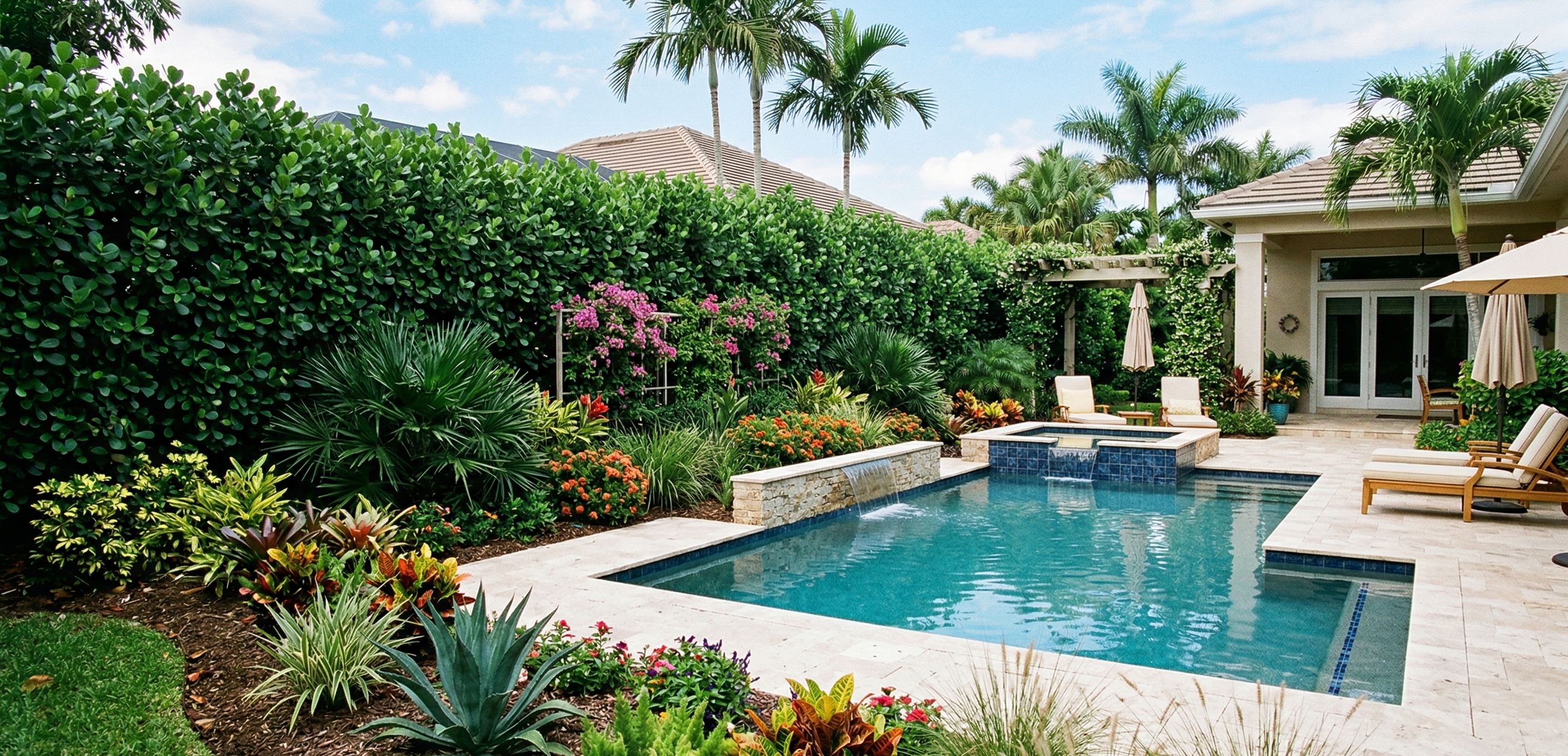
Not a fence problem. How Naples estates achieve genuine outdoor privacy — through layered planting, aluminum screening structures, and grade design that make the outdoor environment feel enclosed without feeling confined.
Privacy as design: Outdoor privacy on a Naples estate is achieved through three layered tools — planting, screening structures, and grade design — not through a single fence line. The best privacy solutions are also design moves that improve the space.
Planting layer: Areca Palm (fast, dense, immediate visual effect), Podocarpus (formal, architectural, holds shape), Clusia guttifera (thick, salt-tolerant, medium height). Layering species at different heights creates a screen that reads as full and established.
Screening structures: Aluminum louvered wall panels, aluminum pergola side panels. HOA-appropriate in most communities because they are classified as architectural elements. Can be combined with planting for a layered solution.
Grade design: A raised pool terrace at 18–36 inches above finished grade at the perimeter blocks eye-level sightlines from the street without requiring tall fencing or planting. The most elegant privacy solution when site conditions allow.
HOA compliance: Port Royal, Moorings, Grey Oaks, and Pelican Bay all have fence height restrictions. Planting-based and aluminum screening solutions are HOA-appropriate in nearly all communities. Confirm with HOA before permitting.
Privacy is the most underaddressed design requirement on Naples estates. Buyers invest $150,000 to $750,000 in an outdoor environment and then find that the pool terrace feels exposed — to the neighboring property, to the street, to the second-floor windows of the home next door. The instinct is to solve this with a fence. HOA restrictions limit fence height to five or six feet in most Naples communities, which provides visual separation from a seated position but not from a standing position in the pool or on the terrace.
The more productive frame is to treat outdoor privacy as a design value rather than a fence specification. The most effective privacy solutions on Naples estates are not fences — they are design moves that create enclosure as a byproduct of improving the outdoor environment.
A layered planting edge that screens neighbor sightlines also creates a green boundary that makes the pool terrace feel like a defined room rather than an open lot. An aluminum louvered wall that blocks road exposure also provides a wind buffer and a surface for ambient up-lighting. A raised pool terrace that eliminates street-level sightlines also creates a hierarchy between the primary outdoor living zone and the surrounding estate grounds.
Privacy and design quality move in the same direction when the privacy is resolved through design rather than through a single screening element applied after the outdoor environment is already built.
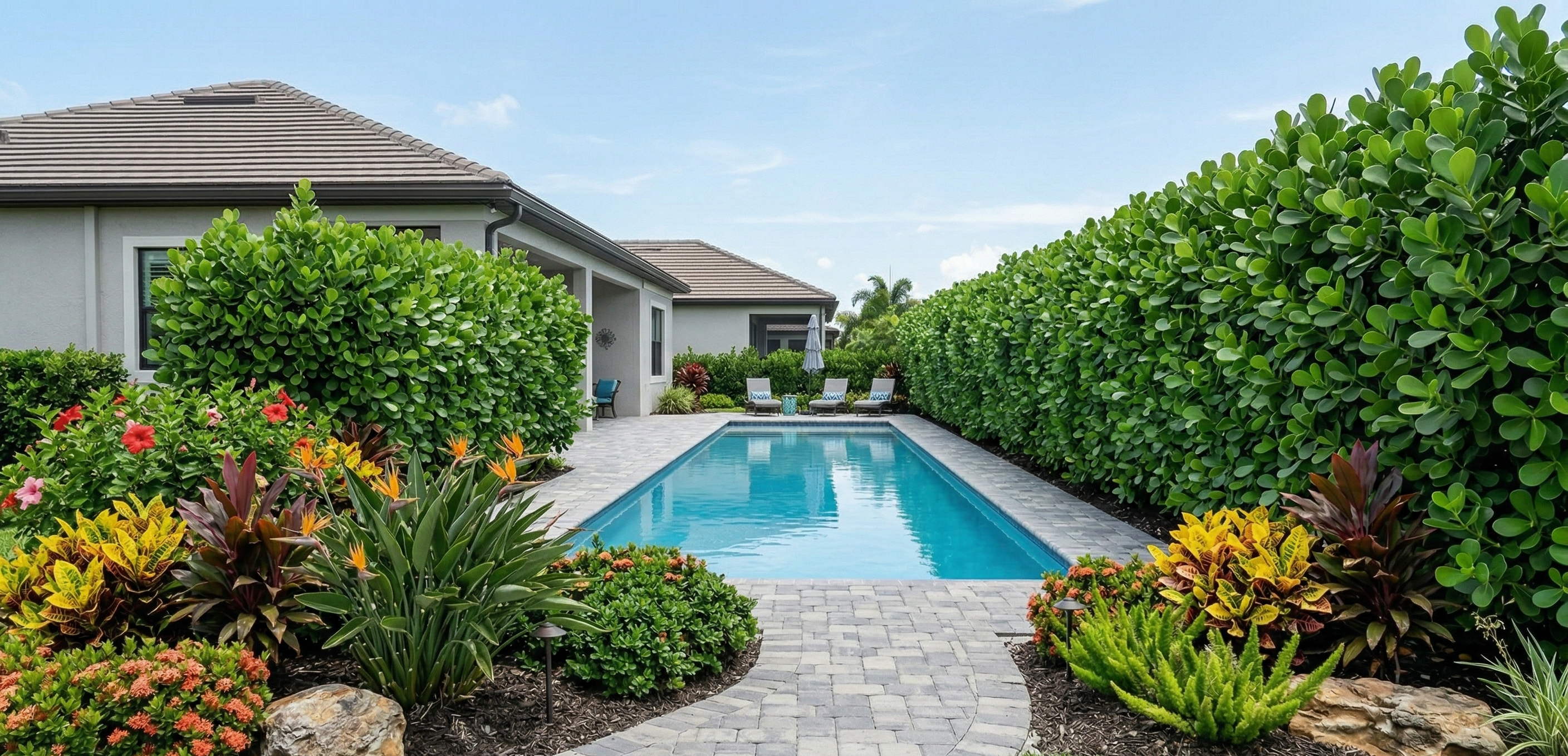
A single species planted as a privacy hedge is the most common approach and the least effective. A single-species hedge has a canopy structure that produces gaps at the base as it matures — Areca Palms, for example, develop a clean stem zone below 6 feet as the clumps mature, which leaves a gap at eye level. A single-species screen also lacks depth — it reads as a single surface rather than as an enclosed boundary.
Layered planting creates a screen that performs well at all heights and reads as a designed landscape boundary rather than a hedgerow. The layering principle: an outer canopy layer at 12–18 feet that blocks elevated sightlines, a middle screening layer at 8–12 feet that provides the primary visual barrier, and a lower infill layer at 4–6 feet that eliminates base gaps and creates a continuous vertical plane from ground to canopy.
Dypsis lutescens. Fast-growing, dense clumping canopy at 12–18 feet. Installed at 10 feet, reaches full screening height in 18–24 months. Positions at the perimeter edge of the planting zone. Not salt-tolerant — positions inland from coastal exposure.
Podocarpus macrophyllus. Tight, shearable formal hedge at 8–12 feet. Holds a precise vertical form with regular shearing. Appropriate for formal and contemporary design languages. Slower growing than Areca — install at 6–8 feet for sooner screen effect.
Salt-tolerant, dense shrub at 6–10 feet. The correct screen species for coastal and waterfront estates within 1–2 miles of the Gulf. Grows as a thick, irregular shrub rather than a formal hedge — appropriate for tropical and coastal design languages.
Viburnum odoratissimum. Dense 4–6 foot shrub that fills the base gap below taller screening species. Planted as an inner layer behind Areca or Podocarpus, it creates a continuous vertical plane from the ground up. Eliminates the stem gap that single-species hedges develop at maturity.
Quercus virginiana. Canopy tree at 25–40 feet at maturity. Used where elevated sightlines (second-floor windows of neighboring property) require screening above the primary hedge height. Positioned at the property boundary, it creates a canopy layer without impeding sightlines from inside the estate.
Florida Sabal Palm. Used at the street-facing perimeter where height is needed but formal hedge character is not appropriate. A dense grouping of Sabal Palmettos at the entry perimeter creates a native-reading screen that is HOA-appropriate in most Naples communities.
Planting-based privacy solutions take 12–36 months to reach their intended height and density. For clients who need immediate screening from day one of occupancy, aluminum screening structures provide the answer — and in most cases, they provide a better answer than mature planting because they are precise, consistent, and do not change over time.
Aluminum louvered wall panels are the most common structural privacy element on Naples estates. They consist of horizontal aluminum louvers set in a powder-coated aluminum frame, mounted to structural posts anchored in concrete footings. Louver pitch is typically set at 30–45 degrees — enough to block direct sightlines while allowing airflow through the panel.
Available in any powder-coat color; estate builds most commonly specify warm charcoal, warm white, or warm bronze to coordinate with the primary design language. Heights from 5 to 10 feet; standard panel widths are 4 to 8 feet wide.
Louvered wall panels are HOA-appropriate in most Naples communities because they are classified as architectural screens rather than fencing. This distinction matters in communities where fence height is limited to 5 or 6 feet — an aluminum screen wall at 8 feet is typically permittable where an 8-foot wood fence is not. Confirm with the HOA before permitting, as community standards vary.
When a pergola or louvered roof structure is already part of the outdoor kitchen or primary seating zone, aluminum side panels integrated into the pergola structure provide privacy on one or two sides of the enclosed zone. The panel sits flush with the pergola column and extends to the height of the roof structure — typically 10 to 12 feet — creating a wall element that is structurally integrated rather than freestanding. This is the most elegant privacy solution for the primary outdoor kitchen and dining zone: the privacy is inherent to the structure rather than added to it.
"The privacy call I get most often is from clients who moved in and realized the pool is visible from the neighbor's second floor. At that point, you need immediate effect — planting at 14 feet installed. That costs significantly more than designing the screening into the project from the start, either as louvered panels or a raised terrace grade. Privacy is a design decision. It should happen at the design stage, not as a retrofit."
— Thomas Gow · Precision Landscaping & Design
Grade design — using changes in site elevation to create visual separation — is the most effective and least visible privacy solution available for a Naples estate. When the pool terrace is raised 18 to 36 inches above the surrounding grade at the property perimeter, standing sightlines from the street or neighboring property are blocked by the grade change itself, without any fence, wall, or hedge at the perimeter line.
The grade change works because the relevant sightline angle changes. At street level, a person looking at an estate property sees the terrace surface and the lower portion of the outdoor environment. A pool terrace that is 24 inches above the street-level grade places the eye level of someone on the terrace 8 feet above the street — above the typical sightline of a person walking or driving past. The privacy effect does not require anything at the perimeter boundary; it comes from the elevation of the use zone itself.
Raised planting beds at the terrace perimeter extend the privacy effect above the grade change. A 24-inch raised terrace edge with a 48-inch planting bed on top creates an 8-foot visual barrier from standing grade — without a fence, and without the maintenance requirement of a hedge. The planting in the raised bed is at a different scale than planting at grade: a 4-foot Podocarpus in a 24-inch raised bed reads as an 8-foot screen from the outside.
Privacy requirements vary by neighborhood based on lot density, HOA restrictions, and typical lot configuration. The correct privacy approach in Port Royal is different from Quail West — not because the desired outcome is different, but because the lot conditions, neighboring property positions, and community standards differ.
| Neighborhood | Primary Challenge | Recommended Approach |
|---|---|---|
| Port Royal | Waterfront exposure, neighboring lots at close proximity, elevated second-floor sightlines common | Clusia at perimeter (salt-tolerant), aluminum louvered panels on non-waterfront sides, no screening on water-facing elevation |
| Moorings | Canal-facing lots, moderate lot density, HOA-moderate restrictions | Areca + Podocarpus layered screen on property boundary sides, louvered pergola side panels for kitchen/dining zone |
| Grey Oaks | Golf-course-view lots often have limited planting options at the golf-course boundary; interior lot sides need screening from neighbors | Aluminum louvered panels on non-golf sides, minimal screening at golf boundary to preserve view, raised terrace where grade allows |
| Pelican Bay | Moderate lot density, some tower-adjacent lots with elevated sightlines from condo neighbors | Maximum-height planting (Live Oak as canopy layer) where elevated sightlines require screening above 15 feet, Areca + Viburnum at ground level |
| Quail West / Olde Cypress | Larger lot sizes, lower density — privacy need is lower but HOA requirements still govern fence materials and heights | Planting-first approach — larger lots accommodate deeper planting buffers. Aluminum panels where specific sightline block is needed. |
Precision Landscaping & Design designs outdoor privacy into every estate environment — through layered planting, aluminum screening structures, and site grading that create enclosure without compromise. Serving Port Royal, Moorings, Grey Oaks, Pelican Bay, and surrounding Naples communities. FL CGC1539932 — permits through Collier County.
Or read: Tropical Planting · Full Estate Build · Hardscape-First Design