
DESIGN LANGUAGES · PRECISION LANDSCAPING & DESIGN

The Night Garden:
Designing for After Dark

Naples outdoor living happens between 6pm and midnight. Most estates are designed for noon. The best ones are designed for 8pm — and the difference is visible the moment you arrive at dusk.

By Thomas Ferrara · 9 min read · Precision Landscaping & Design

The Quick Answer

The Estate Is Designed Twice — Daytime and After Dark

The outdoor estate on a Naples property exists in two versions: the daytime version, which is shaped by sunlight, planting color, and hardscape tone, and the after-dark version, which is shaped entirely by the lighting design. In the SWFL market, where outdoor living happens primarily between 6pm and midnight — after the sun is down, after the heat breaks, after the pool and the outdoor kitchen and the fire features are the focal points of the evening — the after-dark version of the estate is the one that is actually lived in.

Most estate outdoor builds are designed for the daytime version. The landscape architect specifies the planting, the hardscape, the pool form, and the outdoor kitchen. The lighting is specified last — often by a subcontractor given a budget and a directive to light the estate — and installed after construction is complete, with fixtures going wherever the surface conduit can reach.

The result is an estate that looks designed during the day and looks lit at night. The Bismarck Palm has a spike-mounted uplight sitting in the mulch bed at its base. The pool is lit from above with a commercial-grade flood. The outdoor kitchen has surface-mounted strips on the underside of the counter. The estate is visible after dark. It does not feel like a resort after dark.

The difference between "lit" and "resort atmosphere" is the difference between adding lighting after construction and designing the lighting system at the same time as the hardscape — with conduit buried in the right places, fixture positions pre-specified in the construction drawings, and fixtures that are invisible as fixtures and visible only as light.
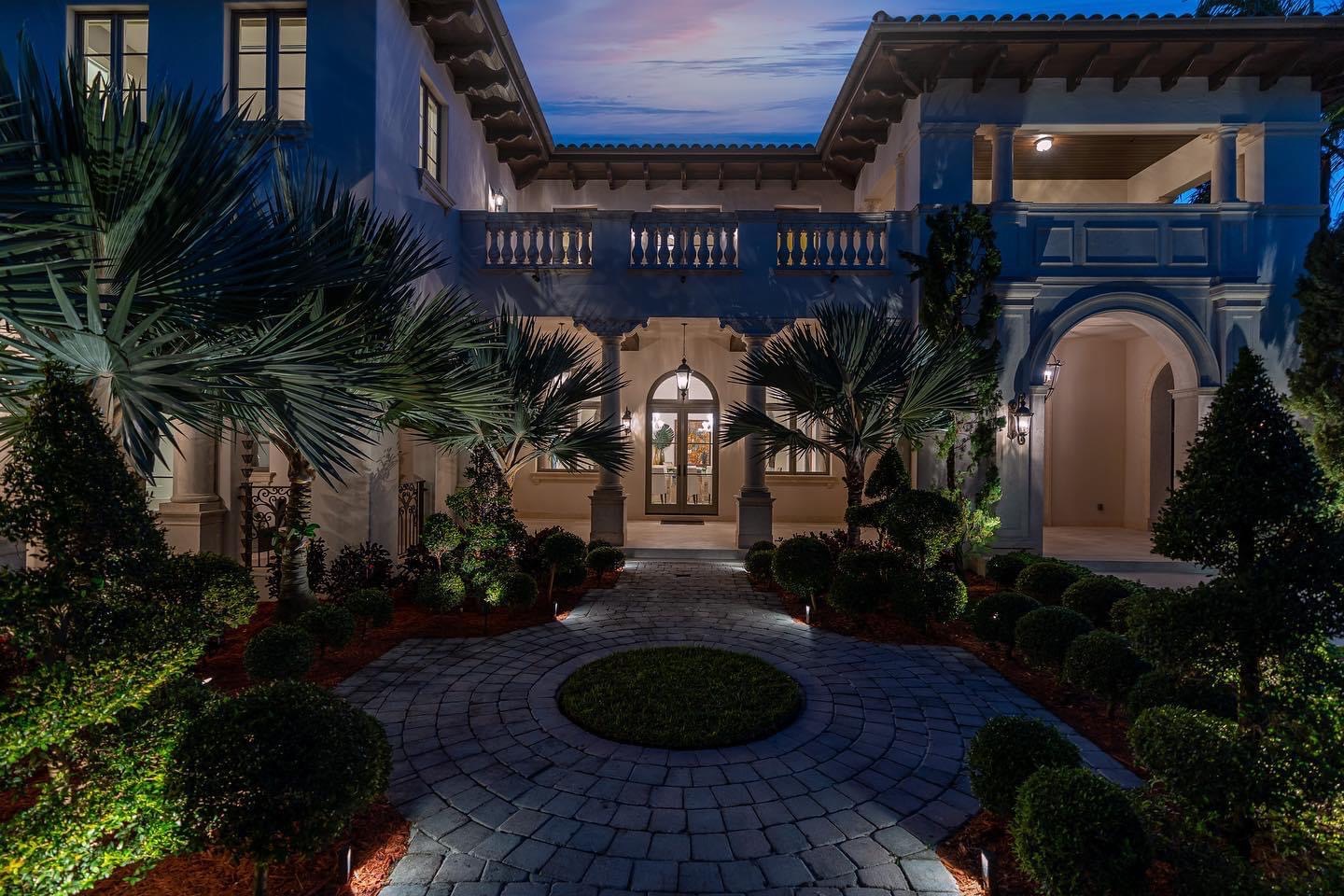
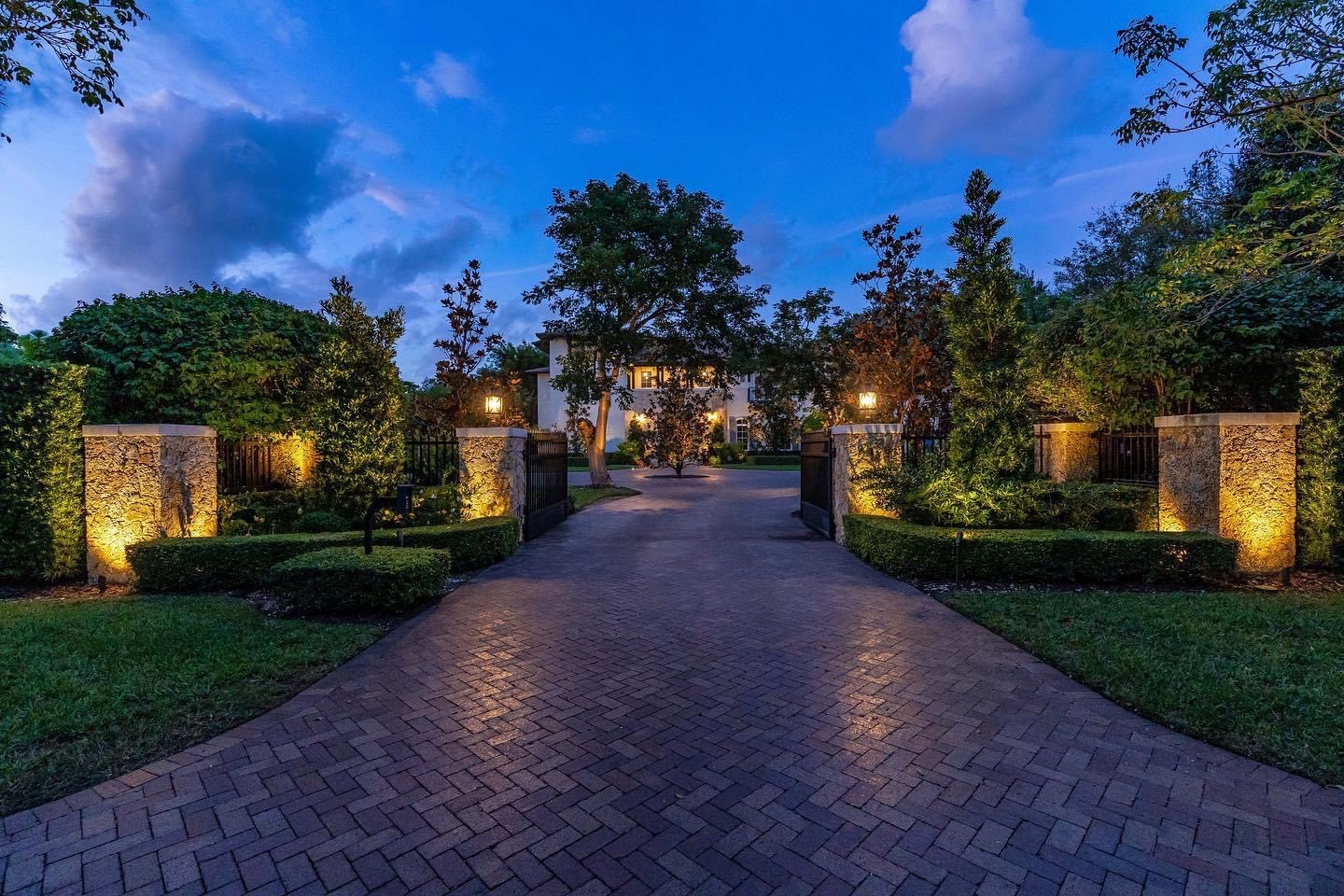
Naples estate after dark with warm amber palm uplighting and water feature illumination
Design language reference: estate lighting at dusk — Unsplash

The Five Lighting Layers of a Night Garden Estate

Layer 1 — Canopy and Specimen Uplighting

Uplighting on specimen palms and canopy trees is the primary layer of the night garden — the one that defines the estate's after-dark character from a distance. A Bismarck Palm or Canary Island Date Palm uplighted from a buried fixture at its base, with a narrow beam angle (10–15°) aimed through the center of the crown, produces a silhouette that reads as a natural nightscape. The crown glows. The trunk disappears. The fixture is invisible in the mulch bed.

The fixture specification: LED, 5–12W, 2700K, narrow beam angle, rated for in-ground burial. The conduit to the fixture is in place before the mulch bed is established. The fixture is adjusted during the first lighting walk-through after planting — angle, intensity, and focus refined with the estate owner present at dusk. This is not adjustable if the conduit wasn't there to begin with.

Layer 2 — Water Feature Lighting

Pool and water feature lighting is the second layer. The correct specification for a Naples estate pool: LED submersible fixtures at the pool floor in 2700K warm white, positioned to illuminate the pool from within rather than from the surface. The pool glows from below — water becomes a warm illuminated surface rather than a dark reflective plane. For spillover features, weir lighting (LED strip behind the weir edge, aimed down the water sheet) produces the warm amber cascade that distinguishes a resort pool from a residential one at night.

Layer 3 — Moonlighting

Moonlighting — fixtures mounted in canopy trees, pointed downward through the foliage to produce dappled light on the hardscape below — is the most naturalistic lighting effect available in outdoor design. It simulates the appearance of a full moon through tree canopy. On estates with mature Live Oaks or other canopy trees, moonlighting fixtures mounted 15–25 feet above the hardscape create an ambient ground-plane light that no path light or low-mounted fixture can produce. The effect is that the hardscape is lit without any visible light source — the light appears to come from the sky rather than from a fixture.

Layer 4 — Step and Path Lighting

Step and path lighting serve a navigation function — and should do nothing more. The correct specification is 3–5W at very low luminance: enough light to safely navigate a step or path edge without disrupting the ambient character of the estate's lighting layers. In-ground step lights recessed flush with the riser face, in a warm 2700K tone, are correct. Bollard path lights should be at a maximum 18-inch height — anything taller creates visible light sources that compete with the canopy uplighting above. The goal is safe navigation achieved through the minimum light required.

Layer 5 — Fire

Fire — outdoor fireplace, fire pit, or fire bowl — is both a lighting element and the focal point of the outdoor living zone after dark. Fire at 1800–2200K produces the warmest, most psychologically engaging light available in the outdoor environment. Positioned adjacent to the outdoor kitchen and seating zone, a fire element provides the ambient warm light that makes the pavilion zone feel inhabited in a way that electric fixtures cannot replicate. In SWFL's climate, a fire feature is usable approximately 6 months of the year (October–April) — during which it becomes the primary gathering element of the outdoor estate.

Outdoor estate at night with warm amber lighting on tropical planting and pool
Design language reference: resort atmosphere after dark — Unsplash

Smart Controls and the Correct Installation Sequence

Zone Control and Smart Controllers

A Naples estate lighting system should operate on smart zone controls that allow individual zone management — canopy uplighting, pool and water features, path and step lighting, outdoor kitchen and pavilion, and gate and entry as separate zones, each controllable from a phone app or home automation system. The astronomical timer function automatically activates the system at dusk and deactivates it at a set time — eliminating manual operation. For seasonal residents, remote control from outside Florida is the primary functional requirement: the system should be fully manageable from any location.

"The single most common lighting problem on estates we're asked to retrofit is conduit placement. Everything the client wants to do — bury the fixture at the base of the palm, put the step light flush in the riser, run the pool edge lighting at the coping — requires conduit that has to be in the ground before the hardscape is poured or the pool deck is installed. If the conduit isn't there, the options are surface conduit or nothing. We specify the full lighting plan at the same time as the hardscape plan. Same drawing set. Same construction sequence."

— Thomas Ferrara · Precision Landscaping & Design

The Correct Installation Sequence

Frequently Asked Questions

Layered ambient lighting — not illumination lighting. The goal is atmosphere, not brightness. Five layers: palm and specimen uplighting at 2700K with buried fixtures; moonlighting from overhead (canopy-mounted, pointed downward); water feature lighting at pool edge and spillover surfaces; step and path lighting at minimum wattage for safe navigation; and fire elements for warm focal point lighting. All layers on smart zone controllers with astronomical timers.
2700K warm white throughout. This temperature matches warm amber tones of natural firelight and produces resort-atmosphere quality that 3000K and higher do not. 2700K makes planting appear lush and warm. 3000K and higher reads as commercial. For underwater pool lighting, 2700K produces the glowing-from-within effect rather than the blue-white appearance of higher-temperature fixtures.
Correctly when the fixture is invisible. A directional LED spotlight (5–12W, 2700K, narrow beam 10–15°) is buried in the mulch bed directly at the base of the trunk, aimed upward through the crown. Conduit to the fixture is buried during initial hardscape construction — not surface-run after. Fixtures on spikes above ground read as residential. Buried fixtures read as resort.
Smart outdoor lighting controls allow zone-by-zone management from a phone app or home automation system. Zones: gate and entry, driveway edge, canopy uplighting, pool and water features, outdoor kitchen and pavilion, step and path lighting, fire features. Astronomical timers activate at dusk and deactivate at a set time — no manual operation. Fully manageable remotely for seasonal residents.

Designing an Estate That Performs After Dark?

We specify and install the full landscape lighting system — palm uplighting, water features, moonlighting, step lighting, smart controls — as part of the estate build, not as an afterthought. Precision Landscaping & Design · FL CGC1539932.

Or read: Landscape Lighting · Lighting Guide Series · Design Languages Guide