NAPLES ESTATE PALM GUIDE · PRECISION LANDSCAPING & DESIGN
Queen vs Royal vs
Alexander Palm.
Naples estate palm comparison — growth rate, mature height, salt tolerance, and which species belongs where. Deep dives: queen palm · Alexander palm.
TL;DR — KEY TAKEAWAYS
- Queen palm = fastest + most common: 2ft/year, fibrous root safe near pools, works in multiples for driveways and pool surrounds. Most versatile estate palm.
- Alexander palm = contemporary + refined: Slender trunk, distinctive canopy. Better architectural signal than queen palm for modern estates. 1ft/year — plan accordingly.
- Royal palm = permanence signal: 60-80ft mature height, self-cleaning, minimal root risk. Used for formal allée driveways in Port Royal and Moorings. Requires crane for specimen installation.
- Sylvester palm = bold specimen statement: Thick trunk, feather fronds, 1ft/year slow growth. Strong architectural presence — typically one or two per estate, not repeating rows.
- Clear trunk height is a design decision: 6-8ft CLT at installation grows over time. Specify the target CLT at 10 years, not at planting — these are different numbers.
Palm selection is one of the first conversations in any Collier County estate build. And it's often framed wrong — as an aesthetic choice rather than a structural and horticultural decision. We think about it differently. We're specifying from the perspective of what a 15-foot specimen looks like at installation, what crane access is needed, how the root system interacts with adjacent hardscape, and what the species reads from the street in 10 years.
This hub compares the five most commonly specified estate palms in Naples. For species-specific installation detail, see our dedicated guides: queen palm tree Naples FL, Alexander palm, royal palm vs queen palm, and foxtail palm vs queen palm.
TABLE 1 — ESTATE CHARACTER & SIGNAL
| Species | Estate Signal | Mature Height | Growth Rate | Best Application |
|---|---|---|---|---|
| Queen Palm | Casual elegance | 40–50ft | Fast (2ft/yr) | Driveways · pool rows · multiples |
| Alexander Palm | Contemporary, refined | 20–30ft | Moderate (1ft/yr) | Contemporary estates · pool features |
| Royal Palm | Formal, permanent | 60–80ft | Moderate (1–1.5ft/yr) | Formal allées · Port Royal · Moorings |
| Montgomery Palm | Formal, contained | 25–35ft | Moderate | Formal look without 70ft commitment |
| Sylvester Palm | Rustic grandeur | 30–40ft | Slow (1ft/yr) | Large lots · specimen statements |
TABLE 2 — INSTALLATION SPECS
| Species | Root Risk | Near Pool / Hardscape | Crane Required | Uplighting Approach |
|---|---|---|---|---|
| Queen Palm | Low (fibrous) | 5ft clearance | No (10–15ft stock) | 3 fixtures, asymmetric |
| Alexander Palm | Low (compact) | Safe near pools | Yes (15ft+ stock) | 2–3 fixtures, canopy spread |
| Royal Palm | Minimal | Excellent near pavers | Yes (20ft+) | 1 fixture at trunk base |
| Montgomery Palm | Low (compact) | Safe near pools | Sometimes (15ft+) | 1 trunk fixture, minimal |
| Sylvester Palm | Moderate | 6ft clearance (Phoenix genus) | Yes (15ft+) | Wide crown — statement fixtures |
Queen Palm (Syagrus romanzoffiana)
The queen palm is the most installed estate palm in Naples. Fast growth, fibrous root system safe near pools, effective in multiples, and available at reasonable specimen sizes from most SWFL nurseries. It earns its position through reliability — but "reliable" is not the same as "best for every application."
Common failure mode: nutritional deficiency, not age. Queen palms are heavy potassium and magnesium feeders. Frizzle top — the browning and curling of new fronds — is a potassium deficiency, not a disease. It's preventable with a proper palm fertilizer program. This is frequently misdiagnosed and attributed to watering when it's actually a fertilization issue.
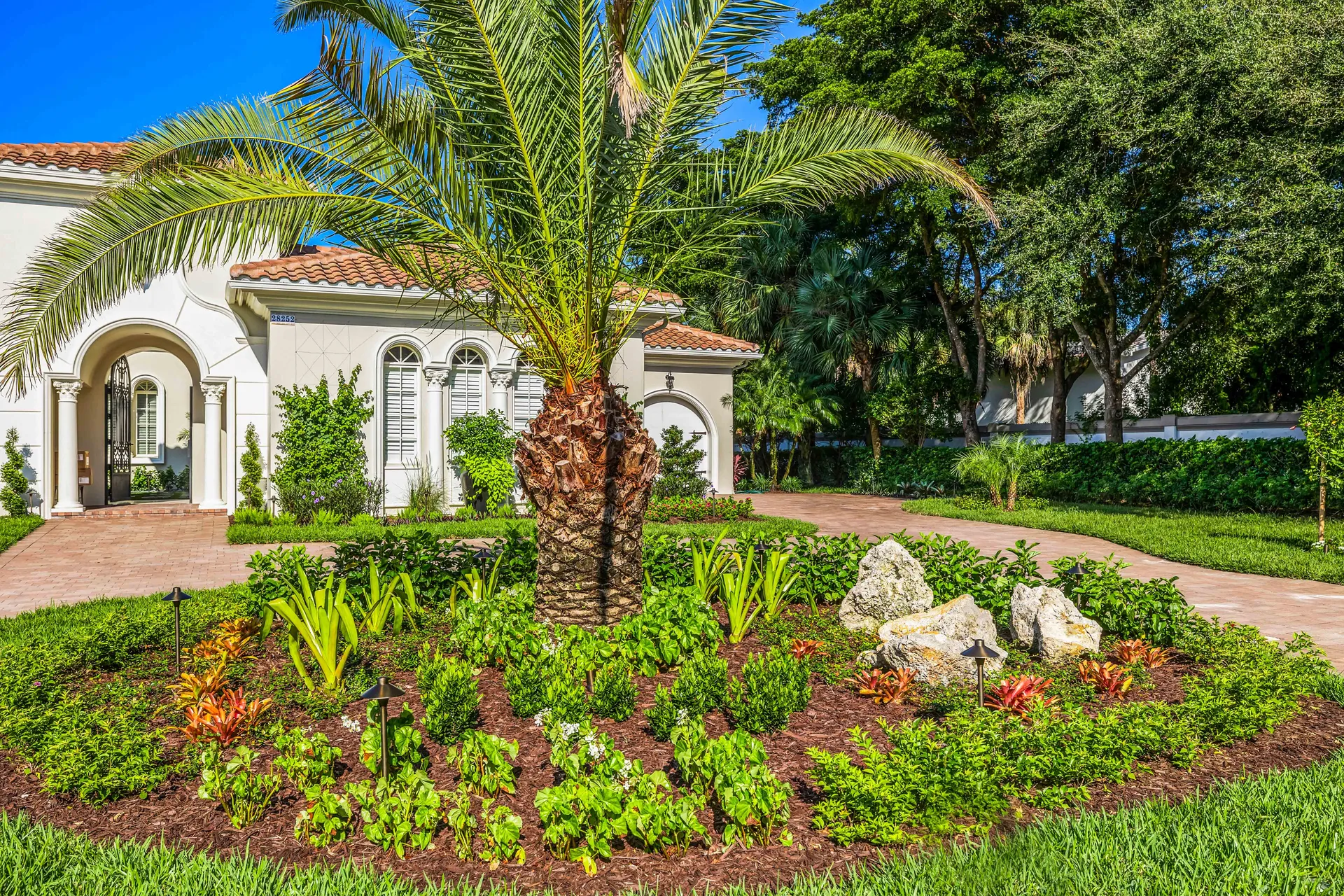
Estate signal: Casual elegance. Effective in multiples along driveways or pool surrounds. Common in Naples but beautiful when spaced correctly and uplighted. Not the specification for a formal Mediterranean entrance — that's the Canary Island Date Palm's territory.
Alexander Palm (Archontophoenix alexandrae)
Alexander palm is the specification when the architecture demands something more refined than queen palm without the commitment of a royal palm. Slender trunk, distinctive wide-spreading canopy, contemporary profile. Often confused with Christmas palm — it is a larger, substantially different species.
Estate signal: Contemporary, architectural, refined. Works for contemporary or transitional estates where queen palm reads as too casual. Best in groups of 3 or 5 for visual rhythm; single specimens as pool deck feature. Often confused with Christmas palm (Adonidia merrillii) — confirm with the specifying LA before ordering.
Royal Palm (Roystonea regia)
The Royal Palm is the permanence signal. Port Royal and the Moorings use it for formal allée driveways. Naples streetscapes use it as the standard. At 60-80ft mature height, it reads from the street as an institution — not just an estate.
Estate signal: Formal, institutional, permanent. The specification for Port Royal waterfront entrances, formal allées on large estate driveways, and any architecture that wants to signal longevity. Native-adjacent — self-cleaning, low maintenance at maturity. Irrigation critical at establishment.
Montgomery Palm (Veitchia montgomeryana)
Montgomery palm occupies the space between alexander and royal — similar formal silhouette to royal palm at a smaller scale. The specification when royal palm's eventual height would overwhelm the architecture or the property boundary.
Estate signal: Formal without scale overwhelm. The right choice when the architecture requires that formal column palm silhouette but the lot or home size doesn't call for a 70ft specimen.
Sylvester Palm (Phoenix sylvestris)
Sylvester palm has a distinctive wide crown and rough, textured trunk — different character than the slim-trunk palms. It reads as rustic grandeur rather than formal elegance. Slower than most buyers expect at around 1 foot per year. Better for larger lots where the wide crown spread is an asset rather than a constraint.
Estate signal: Rustic grandeur. Informal elegance on large lots. The specification for properties that want warmth and texture rather than formal linearity. Not recommended for smaller lots where the crown spread creates maintenance challenges.
A Note on Specimen Sizing
The difference between a nursery palm and an estate palm is clear trunk height. A 10-15ft clear trunk reads as an established specimen from the street. Below that reads as a recently planted nursery tree. The estate specification is always clear trunk height first, total height second. The cost difference between a 7ft clear trunk and a 12ft clear trunk is significant — but the visual impact from the road is the entire point of a specimen palm.
Specifying palms for an estate build in Naples? See how we source and install specimen palms as part of our Naples landscape design and planting service.
RELATED GUIDE
Canary Island Date Palm
The statement specimen for formal Naples entrances — Phoenix canariensis at 10-15ft clear trunk, with crane requirements, uplighting placement, palm weevil management, and Rock & Rose sourcing. Covered separately because it warrants full installer depth.
Read the Canary Island Date Palm Guide →SISTER COMPANY
Rock & Rose Nursery
Specimen palms at estate scale require sourcing from growers with established stock — not nursery inventory. Our sister company Rock & Rose Nursery has access to Homestead, FL growing networks with the specimen sizing that estate builds require. We pre-source during design to ensure availability on schedule.
Visit Rock & Rose Nursery →Common Questions
Queen palm (Syagrus romanzoffiana) is the fastest growing of the standard estate palms in Naples — averaging 2 feet per year in SWFL conditions with consistent irrigation and fertilization. A 10-foot specimen can reach 20 feet in 5 years. Alexander palm grows at roughly half that rate. Sylvester palm is the slowest of the commonly specified estate palms at around 1 foot per year — often slower than buyers expect.
A queen palm in Southwest Florida can live 50-100 years with proper care — adequate irrigation, a correct palm fertilizer program (potassium and magnesium are critical), and drainage that prevents root rot. The common failure is nutritional deficiency, not age: frizzle top (new frond browning and curling) is a potassium deficiency and is preventable. With correct fertilization, queen palms in Naples regularly outlive the landscapes they anchor.
Queen palm (Syagrus romanzoffiana) grows faster (2ft/year), has a wider arching canopy, and signals casual elegance — appropriate for driveways and pool surrounds in multiples. Alexander palm (Archontophoenix alexandrae) grows more slowly, has a slender trunk with a distinctive wide-spreading canopy, and is considered architecturally more refined for contemporary estates. Alexander is often confused with Christmas palm — it is a larger, more substantial species. For contemporary estate applications where a refined silhouette is needed, alexander palm is the stronger specification.
Palms are generally safer near pools than hardwood trees because they have fibrous rather than tap root systems. Queen palm, alexander palm, royal palm, and montgomery palm are all appropriate near pool surrounds with 5-foot clearance from pool walls and equipment. Phoenix genus palms (Canary Island Date, Sylvester) have somewhat more substantial roots — maintain 6-foot clearance. No palm species should be placed directly over pool plumbing or equipment pads.
For formal estate entrances — driveway allées, Mediterranean architecture, Port Royal and Aqualane Shores properties — we most commonly specify Canary Island Date Palm at 10-15ft clear trunk for the statement specimen, or Royal Palm for allée applications requiring height and permanence. Alexander Palm is appropriate for contemporary formal entrances where a narrower silhouette suits the architecture. The right specification depends on the architecture, lot size, and how the entrance reads from the street at 10 years.
SPECIFYING ESTATE PALMS ON YOUR BUILD?
Palm selection is an
installation decision.
Clear trunk height, crane access, root clearance from hardscape, and what the species reads from the street in 10 years — we work through all of it during design, before anything is ordered.
Or read: Canary Island Date Palm Guide · Our Planting Service